Vincenzo Lunardi (1759–1806)
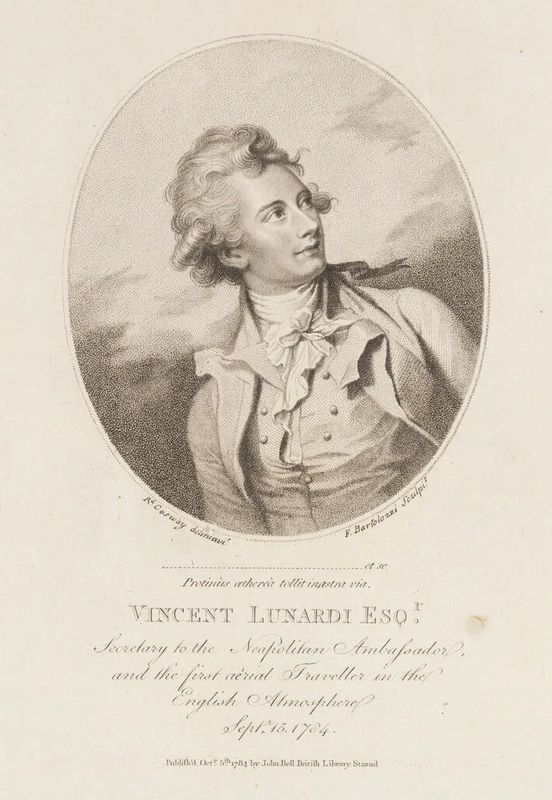
Pat Rogers, University of South Florida
June 2026
The great balloon craze quickly spread to Britain, following the successful experiments mounted in France during 1783 by the Montgolfier brothers, Étienne and Joseph, as well as by Jacques-Alexandre-César Charles. However, the greatest renown locally accrued not to James Sadler, who made the first ascent by an English astronaut at Oxford on 4 October 1784, or even to the eccentric James Tytler, who had already launched himself into the skies above Edinburgh on 27 August. Instead, the recipient of almost all the attention and honours that flowed in that year was an Italian, Vincenzo Lunardi.
There are three main reasons. Firstly, the flight that occasioned all the fuss took place in London, at the Royal Artillery Grounds in Moorfields, on 15 September, with the launch watched by a crowd estimated at anywhere above 40,000 people, among them the Prince of Wales. The interest was such that ringside seats went for a guinea. It cost William Pitt the younger, not long installed as the nation’s youngest prime minister, all of fifty guineas for his viewing perch. In the event Lunardi’s journey stretched over twenty miles from the northern fringes of the capital to a spot near Ware in Hertfordshire. Secondly, Lunardi was an able self-publicist, and persevering in his efforts to find backers. The failure on 11 August of an attempt in Chelsea by another French aeronaut, the Chevalier de Moret, prompted a riot by the disappointed spectators, as well as a satirical print depicting the balloonist as a fraud about to fly off with his ill-gotten guineas. Lunardi knew he had to do better. Thirdly, he was young (just twenty-five), good looking, and a snappy dresser who showed up in impressive uniforms associated with his supporters. Understandably he acquired a collection of female fans.
He was born in Lucca in Tuscany on 11 January 1759. He lost his parents at an early age, and passed into the guardianship of a cousin, the Cavaliere Gherado Compagni, an official at the court of Naples, where the young man joined him when he was about twenty. (He may have travelled to the East Indies prior to this.) In 1780 he accompanied the newly appointed ambassador to London, Prince Francesco d’Aquino, Prince of Caramanico (1738–1795), as secretary. This was to be a major source of patronage during his years in London. The embassy was quite a small affair at 56 Bond Street, but Caramanico was a cultivated individual who favoured men of science and learning, becoming a Fellow of the Royal Society. It may be through this channel that Lunardi came to the attention of prominent figures in the world of science such as Sir Joseph Banks (1743–1820) and Dr. George Fordyce (1736–1802).
Here we have some indication of the impact of balloons on intellectual London. Both of the two last mentioned persons were also members of the Literary Club. Just how caught up members of that group became in the current mania emerges from a letter written by the musician Charles Burney (1726–1814) to his son Charles, a few days after the Moorfields flight:
Rare Balloon fun…. Lunardi’s day was admirable. I went with Sir Jos[hua Reynolds], Mr [Edmund and Richard] Burke senior and junior, Mrs Burke, Lord Inchiquin, & Mr Windham…We went in Corpo…to Sir Joshua’s to dinner where Dr Fordyce gave us the Meeting, & an excellent party, and Balonade we had. The 1st intelligence of Lunardi’s safe arrival on Earth came from Charlotte [the writer’s daughter], who at about 4 o’Clock walking with Mr and Mrs Hoole in their Gardens…saw the Baloon over their heads at a great height - & afterwards saw it descend about 4 or 5 miles off. George Cambridge followed it on horseback- & at Ware conversed with the Aerial Traveller. Charlotte saw him, & was more delighted than if the Man in the Moon had quitted his satellite to visit the neighbourhood of Amwell.
Everyone named here had strong connections with the circle of Samuel Johnson, with the Burney family, or with both—while William Windham (1750–1810) was quite simply a balloon nut.
Little known today is the fact that Charles Burney had a consuming interest in astronomy, second only to his passion for musicology. In 1783 he reported on a description which Benjamin Franklin had sent to Banks from Paris in October 1783 and was read at the Royal Society. Burney also referred to meeting in London a protégé of the chemist Louis-Joseph d’Albert, Duc de Chaulnes (1741–1792), another Fellow of the Society, and speculated that the young adventurer might make “more Celestial discoveries than Cook has terrestrial.” (This may have been de Moret.) On 9 December he wrote to another daughter, Susanna Phillips, regarding a dinner with Johnson and the Duc, which ‘”did not go off so lightly as the last Balon; the inflammable Air of Johnson, that was to lift us up, was damped by sickness.” Susan was to assure her husband that the couple’s daughter (currently aged one year) would live to see “a regular Balon stage established to all parts of the universe that have ever been heard of.” At the dinner, de Chaulnes passed on news involving the work of the Montgolfiers and Jacques Charles. Burney remained enthusiastic about the prospects for this new means of exploring the cosmos. He told Susan, ”If I had wit enough, or energy of mind sufficient to be mad about anything now, it would be about Balons—I think them the most wild, Romantic, pretty playthings for grown gentlemen that have ever been invented, & that the subject, as well as the thing, lifts one to the Clouds, whenever one talks of it.” Congruent with these ideas, he long after embarked on an epic history of astronomy, and completed 600 lines before destroying it.
What might be called today the outreach of the flight has been described by Elizabeth Baigent:
A March for the Flight of an Air Balloon was composed for the occasion by Samuel Wesley. Lunardi became the hero of the moment. A balloon-shaped bonnet was named after the aeronaut (see Robert Burns, 'To a Louse', 1789, where it is used to signify the social pretensions of a country girl), and Lunardi skirts, decorated with balloon motifs, and Lunardi garters were also fashionable. Several descriptions were printed, the best by Lunardi himself in An Account of the First Aerial Voyage in England (1784). Numerous prints depicting the event were published and a drawing by Paul Sandby (Patent Office) survives. A medal was struck to mark the event and Lunardi exhibited himself and his balloon to enthusiastic crowds at the Pantheon.
In the wake of his accomplishment, Lunardi was able to proclaim, “This is an honour the city of London has done me: creating me a member of the Honourable Company of Artillery … of which the Prince of Wales is Captain-General.” At an obscure organisation of the Knights of the Moon, he was greeted by an Ode and nominated First Steward. He kissed the King’s hand when presented at court. Most impressive of all, he was awarded a bronze medal for scientific achievement of the Royal Society. He was perhaps too much of a showman to be considered for election to the body.
From this time, his record was patchy. He was outdone by Jean-Pierre Blanchard (1753–1809) in making the first flight across the English Channel, on 7 January 1785, and in making the earliest one in the US on 9 January 1793. In June 1785 Lunardi stepped down from his craft to allow the presence on board of a female astronaut in the portly shape of an actress named Laetitia Sage, who with a companion flew from St. George’s Fields south of the Thames over Westminster Bridge, Fleet Street and Holborn to Harrow. His fame began to ebb a little, when some of his attempts ended in failure. A much-advertised bid to repeat his triumph at the Artillery Ground in May 1785 proved a flop, literally, when he crash landed in Adam and Eve Gardens, the site of a tavern in Tottenham Court. An ascent from Liverpool not long afterwards did not make much impression on the locals. In Chester he suffered a bad burn to his hand when one of the operatives bungled the loading process. He had better fortune in Edinburgh, where he made contact with some of the leading civic figures. Not all his projects came off, but a voyage from the Castle into Fife produced a happier outcome. He moved on to St. Andrews, where he was congratulated by members of the Society of Gentleman Golfers (forerunner to the Royal and Ancient club), and invited to try his hand at the game—he is said to have shot twenty-one for the first hole. But he was given the freedom of the burgh, and attended a Grand Ball where, by his account, he found “upwards of a hundred beautiful ladies” awaiting his arrival. There were good days at Glasgow and the Cheviot hills near Kelso, but another flop in Edinburgh.
By August 1786 he was ready to leave Scotland. In an unlucky moment he agreed to launch his craft at Newcastle. A young man who volunteered to help him when the balloon broke free was caught up in the mooring line. As a result, he was hoisted to a height of three hundred feet before he crashed down to his death. That was very nearly the end of Lunardi as a balloonist. He went on to invent a tin “aquatic machine” to act as a kind of life jacket to save those in danger of drowning. Tests in 1787 suggested that the device worked well enough, but by this time Lunardi was growing homesick. He returned by way of Genoa in April 1788 after nearly five years’ absence, to be greeted with a hero’s welcome. But a planned flight in his birthplace proved one more fiasco, and the townspeople were so enraged that he had to go into hiding.
From this point Lunardi’s story traces a slowly dying fall. In September 1789 he made his way to Naples, where his old acquaintances King Ferdinand IV and Queen Maria Carolina were awaiting news of the ongoing fate of her sister Marie Antoinette following the Revolution. They gave him a small job in the army, and he made a few short-haul flights around the Bay of Naples. After his patron Caramanico became Viceroy of Sicily, he gave displays with varying success at Palermo in 1790. Three years later, with the rise of Napoleon already threatening the stability of the Neapolitan regime, he moved on to Madrid at the invitation of the Bourbon monarch Charles IV. By the turn of the century, he had allied himself with Portugal against their neighbours, and settled in Lisbon. He died there at the Convento dos Barbadinhos Italianos on 31 July 1806, aged forty-seven. The cause was listed as “a decline,” which generally meant a wasting condition such as consumption. Lunardi’s fame had greatly declined since his halcyon days in London, but in a brief window of time he was among the most celebrated persons in Europe.
All serious study of the topic should now begin with Clare Brant, Balloon Madness: Flights of Imagination in Britain, 1783–1786 (Woodbridge, Suffolk, 2017), a brilliant use of microhistory to explore diverse aspects of the age in terms of politics and nationalism, aviation technology, literary and graphic satire, fashion, the aesthetics of the sublime, and much else. There is a well written popular biography by Leslie Gardiner, Lunardi: The Story of Vincenzo Lunardi (Shrewsbury, 1984). See also the brief but helpful entry in ODNB by Elizabeth Baigent.