Rookeries
Pat Rogers, University of South Florida
June 2026
The use of the word “rookery” began in the nineteenth century, as it applied to parts of London, but the small number of slum areas it designated were there a hundred years before. It is not clear why the term shifted from the home of birds to that of humans, but it probably derived from the old sense of “rook,” as either a verb or a noun, to refer to cheating. By 1829 it was well established in the sense of “a cluster of mean tenements densely populated by people of the lowest class,” as OED put it with a certain hauteur. Henry Mayhew wrote in the 1850s of “visiting a well known rookery of prostitutes.” This was something he would have been able to do a century earlier, most notably in the heaviest concentrations of rookeries, which were located close to either end of Holborn and to the quarter lying at the bottom of St. Martin’s Lane near to its junction with the Strand. These infamous localities will be described shortly.
However, squalid conditions were not confined to those particular spots. George Rudé lists a scattered group of “dangerous districts,” noting that “Some of the oldest of these, going back to Elizabethan times, lay in the belt around the City, in St. Katharine by the Tower, East Smithfield and around the Mint in Southwark. Others developed later: east of the City in Shadwell, Whitechapel and Bethnal Green and, to the west, around Drury Lane, Clare Market, the Fleet Ditch and, fairly generally, in the parish of St Giles in the Fields.” All of these lay outside the historic London walls, in fast-growing parishes that had been pretty much rural enclaves in the medieval period. For the most part, those in the East End had still not fully developed before 1800, although just beyond the Tower ran Rosemary Lane, an old clothes market known for selling stolen garments at cheap prices, and the original “cave of Poverty and Poetry” in Pope’s Dunciad (1728). We can add to these a corner of Westminster, almost in the shadow of the Abbey, where Thieving Lane and Pye Street led to courts and alleys off Tuthill Street that were euphemistically described by John Strype as “ordinary.”
A Distinct Town
Among these islands of deprived living conditions, three localities stood out. They were rookeries in the purest form, each associated not just with overcrowding and poverty but also with crime and various kinds of social disruption. The largest of these was a densely packed neighbourhood between Smithfield and Saffron Hill, stretching northwards from the politer quarters near Holborn, almost as far as Clerkenwell Green. Effectively its character was destroyed by the building in the 1840s of Farringdon Street—for once a popular development for many Londoners, as it was seen to be “ploughing through some of London’s most infamous slums” (Weinreb and Hibbert, 273). The new road also consigned another section of the toxic Fleet River to a hidden existence underground.
The site of the rookery was vividly evoked by Dorothy George in her classic account of eighteenth-century life in the capital:
One of the worst of these districts, and one of the best-situated to be a refuge for evil-doers, was the network of lanes and alleys round Chick Lane and Field Lane communicating with Turnmill Street and Cow Cross. In a small space authority was divided between the City and Middlesex and between the parishes of St. Sepulchre’s, Clerkenwell, St. Andrew Holborn and the Liberty of Saffron Hill. The way in which the possibilities of the place (known as Jack Ketches Warren) were exploited appears in the account of a night search towards the end of the Gordon Riots: “One of our detachments visited Chick Lane, Field Lane, Black Boy Alley and some other such places….These places constitute a separate town or district calculated for the reception of the darkest and most dangerous enemies to society….The houses are divided from top to bottom, and into many apartments, some having two, others three, others four doors, opening into different alleys. To such a height is our neglect of police arrived, the owners of these houses make no secret of their being let for the entertainment of thieves.” (George, 82)
George notes that the bad character attributed to these places had persisted for a very long time. She continues:
The Turnmill (or Turnbull) Street and Cow Cross district had long been notorious. Falstaff says that Justice Shallow “hath done nothing but prate to me of the wildness of his youth and the feats he hath done about Turnbull Street’. Nash, in Pierce Penniless (1595), enumerates the places with an evil reputation: Shoreditch, the Spittle, Southwark, Westminster and Turnmill Street. Later, The Merry Man’s Resolution gives a similar list for pre-Restoration London: St Giles in the Fields, Turnbal Street, White Crosse Street, Golden Lane, and every street between Golden Lane and Smithfield. Saffron Hill, a den of iniquity in the time of Dickens, was notorious for its brothels in the reign of James I. (George, 82–83)
In fact, some of the most atmospheric passages in Dickens occur in Oliver Twist, as noted in the Oxford Reader’s Companion to Dickens:
There were areas of dire poverty in and around Clerkenwell and the eastern part of Holborn throughout the first half of the 19th century, the worst part being concentrated near Saffron Hill…. Oliver Twist is conducted by the Artful Dodger through a labyrinthine descent from Islington towards Fagin’s den in Field Lane: “A dirtier or more wretched place he had never seen. The street was very narrow and muddy; and the air was impregnated with filthy odours.” In “the filthiest part of Little Saffron Hill” lay “The Three Cripples,” the insalubrious public house frequented by Sikes and Fagin, “a dark gloomy den, where a flaring gas-light burnt all day.” (Schlicke, 360)
Once more, this is a scene that would have looked, and smelt, very little different in the earlier part of the Georgian age. Towards the end of the novel, the principal villain meets his come-uppance in an equally poisonous riverside corner: “South of the River Thames lay some of the most noxious and disease-ridden rookeries, notably Jacob’s Island in Bermondsey and the Mint in the Borough. Jacob’s Island, ‘the very capital of cholera,’ was joined to the Thames by the filthy inlet formed by the River Neckinger… Here Sikes meets his death.” (Schlicke, 360–61)
The Cow Cross district was cut across by the Fleet Ditch, still open to dispense its stench over the neighbourhood. Although it had never legally been a sanctuary, its vertiginous network of narrow alleys served as a refuge for many of the underclass—not just criminals, but all kinds of individuals who found themselves down and out in London for one reason or another. A description of Field Lane, at the heart of local activity, was given in the later part of the century, characterizing it as “A sort of distinct town, or district calculated for the reception of the darkest and most dangerous enemies of society; in which when pursued for the commission of crimes they easily conceal themselves and readily escape” (cited Hitchcock and Shoemaker, Hanging Court, 13).
Not that their surroundings gave any group full protection from authority. The most famous “molly house” where male homosexuals gathered was run by “Mother Clap” next to a tavern in Field Lane, which paralleled the course of the Ditch towards Holborn at the foot of Saffron Hill. In 1726 a campaign sponsored under the aegis of the influential Societies for the Reformation of Manners led to the arrest of seven men for “the heinous and detestable sin of Sodomy,” a capital offence, as it remained until 1861. The first of these was taken up at Mother Clap’s house on the evidence of informers, who had either undergone intercourse with the accused or witnessed the conduct of those present, which included mock weddings between two men. The verdict is curtly stated in the Old Bailey proceedings: “Guilty. Death.” Soon afterwards, Margaret Clap “was indicted for keeping a House in which she procur’d and encourag’d Persons to commit Sodomy.” An informer gave further details of what went on in the molly house. Clap stated in her defence that “it ought to be considered, that she was a Woman, and therefore it could not be thought that she would ever be concern’d in such abominable Practices.” However, “the Evidence being full and positive, the Jury found her Guilty.” She was sentenced “to stand in the Pillory in Smith field, pay a Fine of 20 Marks, and suffer two Years Imprisonment.” A newspaper report on 30 July 1726 told the public that “The populace treated her with so much severity that she fell once off the pillory and fainted upon it several times,” the kind of treatment that only deeply unpopular figures received at the hands of the spectators (Hitchcock and Shoemaker, Hanging Court, 16).
It is demonstrable that criminality in the rookeries often went along with drink (especially gin), impoverishment, and poor housing conditions—intertwined snares that entangled many hapless immigrants from Ireland among others. Some of the connections were made explicit in 1753 by Saunders Welch, at his time High Constable for Holborn, and later a distinguished Justice of the Peace:
There [has] within a few years arisen in the outskirts of this town a kind of traffic in old ruinous houses which the occupiers fill up with straw and flock beds, which they nightly let out for twopence for a single person or threepence for a couple. Four or five beds are often in one room, and what with the nastiness of these wretches and their numbers such an inconceivable stench has arose from them that I have been hardly able to bear it the little time that my duty required my stay. Spirituous liquors afford means of intoxication and the houses are open all night to entertain rogues and receive plunder. Great numbers of desperate fellows have been taken out of these places and executed. One woman occupied in the parish of St. Giles near twenty of these places. Black Boy Alley abounds with them and they were the shelter of that dreadful gang who about nine years ago robbed and wounded people at noonday. ...As these houses were largely inhabited by the Irish, the landladies seem also to have been frequently been Irish. (quoted George, 88–89)
Crime and Punishment: Black Boy Alley
Periodically, bouts of serious criminal behaviour broke out in the area, that alarmed many Londoners. A group of street robbers active in the mid 1740s set off a high level of what is now seen by some as “moral panic” (Hitchcock and Shoemaker, London Lives, 180–91). They were called the Black Boy Alley gang, from their base off Chick Lane—just a stone’s throw away from Mother Clap’s establishment. Their methods were revealed by a trial at the Old Bailey in December 1744. One of the gang who had agreed to turn king’s evidence deposed on the witness stand that he had been among five members who had set out from Chick Lane on a series of street robberies, armed with “cutlasses.” They must have met up with colleagues on their rounds of the district around the notorious Moorfields, because the victim of the attack at the centre of this trial claimed that he had been pinned up against a wall by “a lad about the size of the little boy at the bar”—for some reason, the alleged assailants are described as youths, though some at least must have been adults. A particularly violent individual within the group was John Potbury, known as Jack the Sailor—all his comrades had aliases reminiscent of the thieves in The Beggar’s Opera, such as Long Will (William Norwill), Gugg (Willaim Billingsly), Scampy (Henry Gadd), and Nobby (Joseph Field). However, most of them were ready enough to “cut and slash” in pursuit of their booty.
A key aspect of their modus operandi was a willingness to go to the assistance of colleagues who had been taken up. A graphic instance occurred in 1742, featuring one of the group involved two years later in the assault just described. He was caught in the act of picking a gentleman’s pocket, and taken to be examined by the soon to be knighted Bow Street magistrate Thomas De Veil (remembered today, if at all, mainly because of his shadowy appearance in works by Hogarth and Fielding). A colleague quickly came to the aid of the miscreant:
[Billingsley] immediately makes the best of his Way to Black-Boy-Alley, in Chick Lane, to raise a Posse to rescue him; he got six of his own Gang, and all had got large Broomsticks; just at Holborn Bars they met the Coach, and one of them went to the Coachman and ordered him to stop his Horses, or else he would knock his Brains out, whilst the others got to the Coach-door, and let out their Companion, and carried him off in Triumph to Black-Boy-Alley, in Defiance of Justice. This was about two Years ago, and they always afterwards went with Pistols, Hangers, and Cutlasses, for fear any of the Thief-takers should offer to take them; they generally went in Numbers, sometimes six, and sometimes ten.
A similar episode in 1744 once more involved Billingsley, this time the rescuee rather than the rescuer, after his arrest in Drury Lane. Within three minutes, “a Posse of twelve Villains” arrived on the scene. When the City Marshal and his assistants drew their guns, members of the gang shouted out that they defied all power. Having returned fire, and wounded the Marshal, they made their getaway, probably hurrying back to Chick Lane, where they generally shared out their booty. In the face of events like these, it does not seem that “moral panic” quite conveys the realities of the time. All this took place within a comfortable distance of the gracious new squares of Bloomsbury. In reading such an account, it can be hard to feel sure that the setting lies among London streets in the age of Handel and Samuel Johnson, rather than the saloons and brothels of Dodge City in the era of Wyatt Earp and Doc Holliday.
We know that all those most active in the gang at this period were based either in St. Giles (which included the rookery of Seven Dials, to be described shortly), or in the vicinity of Chick Lane. This comes from a confession by a gang member turned prosecution witness: “Billingsly, Potbury, and I, lived in St. Giles’s, and the others lived in Black-boy-alley…. I lived in Black-boy-alley, before I went to St. Giles’s. Jack Neaves and Popes had the house, and let it out to us; Billingsly lived at Pope’s, and Potbury and I lived at Giles’s.” Thick as thieves, one might say; and Potbury, Billingsly, Field, and Gadd were all among eighteen felons executed at Tyburn on 24 December 1728. As the authorities hoped, publicity generated by the gang’s activities had encouraged informers and thief-catchers to come in from the cold. A sombre end to this particular phase in the history of the rookery—though far from the end of serious crime in the locality.
Seven Dials and the Bermudas
Two other rookeries were especially well known by the mid-eighteenth century. One was the huddle of intertwining streets around Seven Dials, located in the parish of St. Giles’ in the Fields. Here, a century earlier, the parochial character had largely matched its bucolic title, but all that had now changed, as with St. Martin’s in the Fields immediately to the south, owing to the inexorable growth of London, as its centre of gravity stated to slide away from the historic City. Increasingly, across the less favoured quarters of the town, people were herded together in appalling proximity. The district as a whole was famous for prostitution, for gin shops, and for harbouring outcasts, along with prisoners on the run such as the sneakthief and escape artist Jack Sheppard.
When it was first created in the 1690s, Seven Dials had formed a planned development to be inhabited by people of substance, with roads (six at first) radiating out from its impressive centre-piece, a tall Doric column faced with sun dials. The scene was neatly versified by John Gay in Trivia (1716): “Where fam’d Saint Giles’s ancient Limits spread, / An inrail’d Column rears its lofty Head, / Here to sev’n Streets, sev’n Dials count the Day, / And from each other catch the circling Ray.” Sadly, it took only two generations for the neighbourhood to decline into a no-go area where the feeble troops of law enforcement were sometimes reluctant to show themselves. As indicated, it lay at the heart of the rapidly expanding district of St. Giles, known for its links with “boozing dens,” women of the town, and generally “London’s fleshier or more liquid pleasures” (Gatrell, City of Laughter,135, 94).
Not for nothing does St. Giles, the patron saint of beggars, preside over the louche events of The Beggar’s Opera (1728), an association with the parish so close that Vic Gatrell refers to it as “mendicant St Giles’s” (City of Laughter, 142). This was the setting in which Gay located the tricks and cheats utilized by his cast of thieves and whores. They pass a convivial evening at “A Tavern near Newgate,” the fearsome prison at the other end of Holborn—a short journey that many of them would make in the opposite direction, on their way to be hanged at Tyburn. When the hero Macheath wants female company, he sends out for some conveniently accessible “ladies.” One is to be found in Vinegar Yard, just of the edge of the rookery, and the site of the large parish workhouse opened in 1726, with “the rest of them [from] somewhere about Lewkners’s Lane,” a notorious haunt of the common vices that lay a very short distance away. Which of these addresses sheltered the operations of Jenny Diver or Suky Tawdry, we are not told.
For his part, the real-life Jack Sheppard had “spent his nights hanging about the dives of Lewkenor’s Lane, and finally made friends with one of the girls at the ‘Black Lion,’….a few doors down from ‘The Black Boy’ where Andrew Wild kept a ‘Lock’ for street pickpockets.” A lock was thieves’ argot for a place where stolen goods were received; Andrew Wild was a brother of the hated thief-taker Jonanthan Wild (a model for Peachum, also in The Beggar’s Opera), and he himself kept “a Case at the Black Boy in Newtonhouse Lane , where his Wife Locks [receives] to a Parcel of young Lads that goes upon the Sneak” (Howson, 208, 134). Newtonhouse Lane was simply another name for Lewkenor’s Lane, while case was defined by Nathan Bailey as “a house where thieves, pick-pockets, whores, house-breakers, highway-men, and all the loose, idle, furacious crew meet and drink…and revel.” (We now need a gloss to the glossary: furacious meant given to thieving.) On one of the first occasions that Sheppard was taken into custody, at an alehouse in Seven Dials, he was committed to the St. Giles’ Roundhouse, which stood in Cole Yard directly parallel with Lewkenor’s Lane. He was lodged in an upstairs room there, but to no avail. Even Alcatraz couldn’t hold him—he made his escape through the roof within three hours.
Once enmeshed in the star-shaped pattern of Seven Dials, it was easy to get lost or to lose a pursuer, who might not know which path to follow among the branching routes that spread out in all directions—not to mention winding passages that linked some of them. In Trivia, Gay imagines a country bumpkin who flounders around in “the narrow Alley’s doubtful Maze,” comparing the twists and turns to those of the Cretan labyrinth from which no one could escape; but in truth such a road system might have been designed to prevent visitors from penetrating the inner secrets of the rookery. It was not Theseus but engineers of the Metropolitan Board of Works, headed by Sir Joseph Bazalgette, who razed parts of the convoluted warren when Shaftesbury Avenue was built between1877 and 1886.
One of the regular features in the proceedings at the Old Bailey is mention of dishonest activities in Seven Dials, typically small thefts of clothing, followed by attempts to dispose of the goods in Monmouth Street. This was the premier market in London for the sale of second-hand clothes, along with Rosemary Lane further east. Naturally, it does not escape reference from Trivia, in a passage that suggests where “the Wants of Life” can be found in the capital: “Moorfields old Books; and Monmouth-street old Suits.” The road also helped to form a defensive wall around the edge of the rookery, as part of a lozenge-shaped sequence continued by King Street, Castle Street, and West Street, all of which turn up on frequent occasions in the court proceedings. Several of the traders in Monmouth Street also served as pawnbrokers. A scene in the second book of Fielding’s Amelia tells how the heroine’s young maid made off with some shifts of her mistress, and pawned them in Monmouth Street for much less than their value. When she is taken before the magistrate, it emerges that the shopkeeper has twice been acquitted at the Old Bailey of receiving stolen goods, even though the evidence against him was plain enough. Both parties in the sale are able to escape without punishment, on legalistic grounds, and the hero Booth is left to reflect that “one would almost think our laws were rather made for the protection of rogues, than for the punishment of them.”
Porridge Island and the Bermudas
Two adjoining areas noted among other things for their cookshops formed a single well defined space, with the crowding and poverty sufficient to earn them the name of a rookery. The less intimidating became known as Porridge Island. Following its demise in the early nineteenth century, as a result of major redevelopments in the vicinity of Charing Cross and Trafalgar Square, this account was given by a later topographer:
At the bottom of St. Martin's Lane was a nest or rookery of narrow lanes and streets, which rejoiced in slang names, such as “Porridge Island,” “The Bermudas,” and the “Straits of the Strand.” The names in course of time became classical, being constantly imported into the comedies of the time by Ben Jonson and other authors. From the allusions to them which occur, it is clear that they were occupied by a low lot of inhabitants, who indulged in gin, ale, and fighting. Porridge Island, especially, was filled with second-rate cook-shops….
Another edition of the same source observes that “The greater part of this rookery was swept away about the year 1830, but a considerable portion of the low courts remain about Bedfordbury” (Walford, 3: 141). It occupied a tangled collection of small streets behind the church of St. Martin’s in the Fields, running between St. Martin’s Lane to Round Court, not far removed from the western end of the Strand. “The low lot of people” included some individuals who escaped poverty and went on to become notable figures in society, such as the painter James Barry. A satire on the Royal Academy in 1786, locates the home of its author, “Anthony Pasquin” (John Williams), as “Porridge Island, Up Three-pair of Stairs backwards,” that is the traditional garret of starving poets and artists. Barry appears as “Jemmy O’Blarney” in the farce that follows Pasquin’s dedication.
Few, except perhaps some of the humble inhabitants, can have regretted the demolition of Porridge Island. Some reformers claimed, we are told, that “one house in every five or six in that patch sold gin or was a brothel” (Gatrell, Bohemians, 34). Just before the entire district was rooted up, an artist named George Sharf made a water-colour sketch of a narrow passage that zigzagged across its breadth, called Church Lane. The image shows the western portion of the alleyway, blocked at the end by an unusual rear view of the familiar outline of St. Martin’s church. It seems to be a daylight scene, but almost everything at ground level is shrouded in a pall of deep shade. The residents must have passed a lot of their time there like troglodytes.
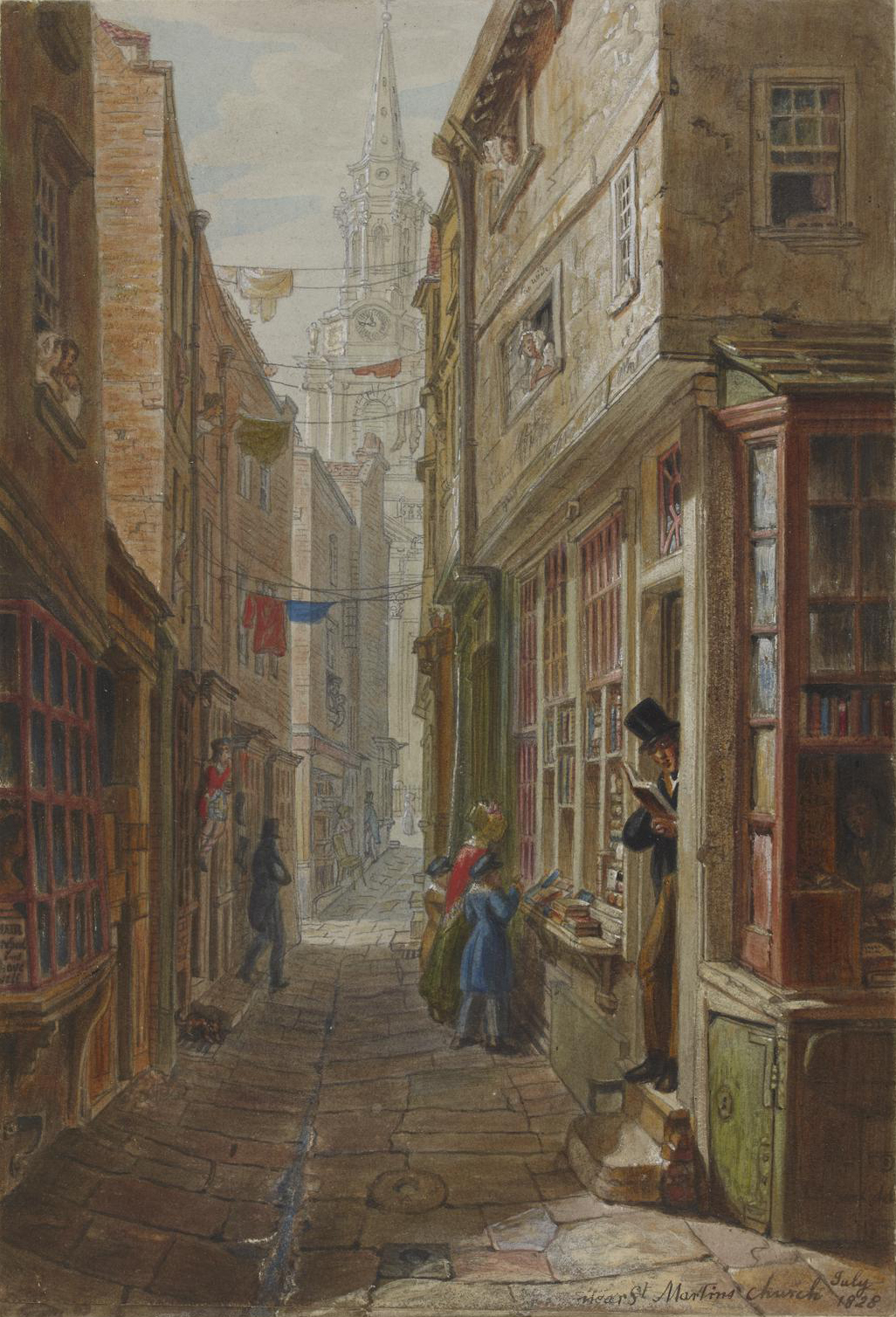 Church Lane, by George Scharf (1828). British Museum 1862,0614.107. This image can be used for non-commercial research or private study purposes. In certain other jurisdictions it is considered to be in the public domain. |
The Bermudas had a longer and more clouded history. Here we enter a battleground of scholarly disputation. The name was applied to a tract of land, abutting the Island, that extended from St. Martin’s Lane eastwards as far as Bedford Street, and northwards from Chandos Street to New Street, perhaps as far even as Long Acre. Its name may commemorate the British “discovery” and settlement of Bermuda from 1609, thought to lie behind the plot of The Tempest (1610–11), and then its subsequent history as the first colony to import slaves from 1616. Ben Jonson refers to such a place in Batholomew Fair (1614), though this has sometimes been seen as referring to the ancient sanctuary near the Mint in Southwark, and mentions it elsewhere as “the Streights.” Laura Wright suggests that the penal history may be the semantic origin of the name, and explores an alternative designation that came into use later, namely “the Caribbee Islands.” To complicate matters further, there may have been confusion with a variant spelling found in Ariel’s speech in The Tempest (1.2.227), “the still-vex’d Bermoothes,” which has been associated with an area off Drury Lane which served as a refuge for debtors and felons. A glossary published in 1822 defined Bermoothes as ”A cant term for certain obscure and intricate alleys, in which persons lodged who had occasion to live cheap or concealed; called also the Straights…They are supposed to have been the narrow passages north of the Strand, near Covent-garden.” However, this usage found in Renaissance drama seems to have died out in the eighteenth century, and no contemporary guide to London from the period recognizes the continuing existence of such a place of sanctuary. In default of further information, it seems safe to say that the Bermudas and its variants were confined to the rookery close to St. Martin’s Lane, as the older sanctuary near Drury Lane (if it existed) was gone by the time that the British settled Bermuda.
The main artery running south through this tangle of small alleys was Bedfordbury, descried by Strype with scarcely concealed distaste as “on the Backside of St. Martin’s Lane, of no great Account either for Buildings or Inhabitants” (Strype, 2: 74). None of the adjoining yards rates higher than “ordinary” or “very ordinary,” about as dismissive as Strype allows himself to be. A contemporary website devoted to Covent Garden reports that on the fringes of the Bedford estate, by 1700, the Dukes of Bedford “had practically lost control over the buildings. The lack of landlord control meant the buildings’ standards were far from adequate and the area started to disintegrate into slums, with large groups of families being squashed into upper storeys above the shop levels” (Memoirs of a Metro Girl: Georgian shop life and slum makeovers at 23 and 24 Bedfordbury). This liminal situation, set among the relative grandeurs of Covent Garden, the Strand and Charing Cross, exemplifies some of the conditions enabling a gradual slide towards low life which was the fate of the rookeries.
The main secondary sources quoted here are: two books by Vic Gatrell, City of Laughter: Sex and Satire in Eighteenth-Century London (New York. 2006), and The First Bohemians (London, 2014); M. Dorothy George, London Life in the Eighteenth Century (London, 1925; frequently reprinted); Gerald Howson, Thief-Taker General: The Rise and Fall of Jonathan Wild (New York, 1971); George Rudé, Hanoverian London 1714–1808 (Berkeley, 1971); Andrew Sanders, “London: Slums and Rookeries,” in Oxford Reader’s Companion to Dickens, ed. Paul Schlicke (Oxford, 1999), 360-61; Walter Thornbury and Edward Walford, Old and New London: A Narrative of Its History, Its People, and Its Places, 6 vols (London, 1873–1878); The London Encyclopædia, ed. Ben Weinreb and Christopher Hibbert (New York, 1983); and two books by Tim Hitchcock and Robert Shoemaker, Tales from the Hanging Court (London, 2010), and London Lives: Poverty, Crime and the Making of a Modern City, 1600–1800 (Cambridge, 2015).The last two authors are responsible for other valuable works in the field, including Hitchcock’s Down and Out in Eighteenth-Century London (London, 2004); and Shoemaker’s The London Mob: Violence and Disorder in Eighteenth-Century England (London, 2004). Quotations from the law reports are taken from Proceedings of the Old Bailey Online, 1694–1913 (oldbaileyonline.org), with other materials drawn from London Lives, 1690–1800 (www.londonlives.org).
A primary source is John Strype (rev.) A Survey of the Cities of London and Westminster: Containing the Original, Antiquity, Increase, Modern Estate and Government of those cities. Written at first in the Year MDXCVIII. By John Stow, Citizen and Native of London, 2 vols (1720).